
Kidnapping: The Silent Crisis and How It’s Reshaping the Security Landscape in SA
Kidnapping in South Africa has entered a new phase—defined by sustained growth, broader targeting, and increasing operational sophistication, not by isolated incidents. It is now firmly embedded in the country’s violent crime landscape, with clear indications that the trajectory remains upward.
What was once perceived as a crime affecting a limited segment of society has evolved into a widespread risk that cuts across industries, income groups, and communities. Data released by the South African Police Service (SAPS) confirms that kidnapping is no longer a marginal issue, but a consistent and elevated component of the country’s broader crime landscape.
Across the country, criminal syndicates have become increasingly coordinated, technologically enabled, and intelligence-driven in their execution of kidnappings and extortion-related crimes.
The scale of the problem is reflected in national figures. It has been reported by SAPS crime statistics that there is a continued upward trajectory in kidnapping-related crimes over the recent years, particularly in urban and economic hubs where syndicates exploit mobility, digital communication, and surveillance weaknesses.
South Africa recorded more than 18,000 kidnapping cases in 2025, continuing a steady upward trend that has been building over several years.
This increase is not temporary or isolated; it represents a structural rise, with kidnapping cases having more than doubled since 2024.
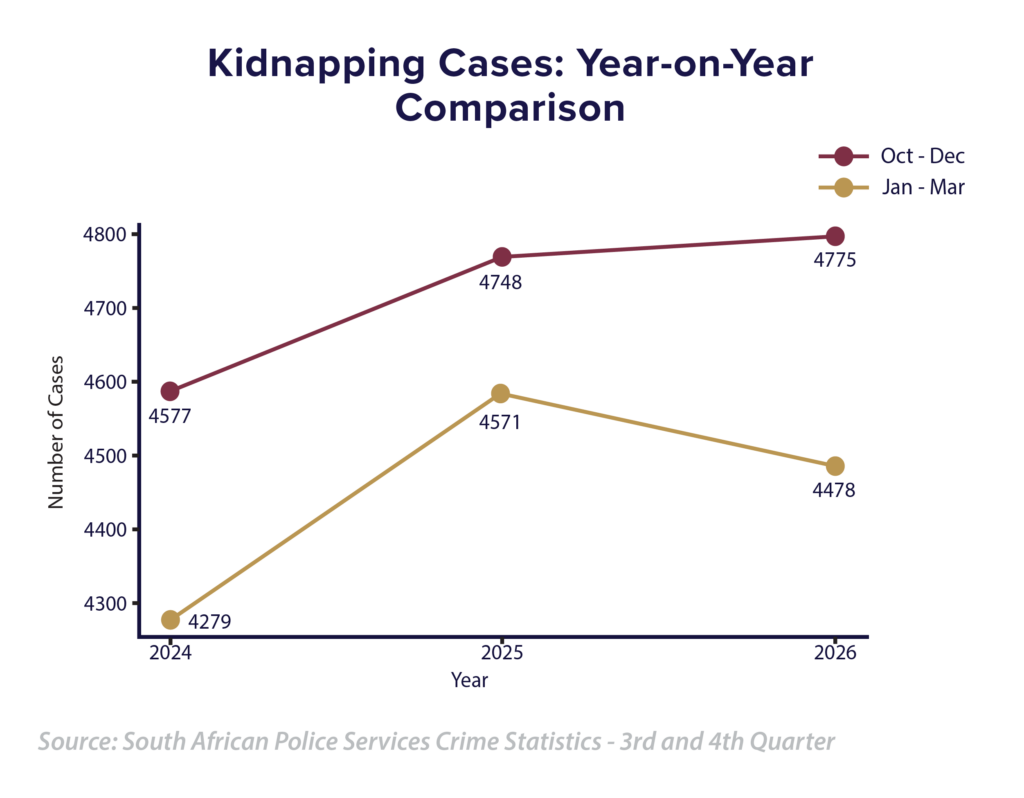
During the period from October to December 2025, a total of 4,775 kidnapping cases were officially recorded nationwide. When translated into practical terms, this equates to an average of over 1,500 incidents per month and over 50 cases per day. (saps.gov.co.za).
These figures point to a continuous pattern of activity rather than sporadic spikes, underscoring the sustained pressure within this crime category
Although there are slight variations across reporting periods, the overall trajectory remains upward.
Data indicates a 2.0% increase in kidnapping-related incidents between January 2025 and March 2026 when compared to earlier periods.
More importantly, crime intelligence and industry observations highlight a shift in the nature of these crimes.
Kidnapping is increasingly linked to organised, economically motivated activities, including ransom demands, extortion, business-related targeting, and incidents connected to vehicle hijackings and armed robberies.
Further analysis of SAPS crime statistics for the 2025/26 financial year highlights that kidnapping remains among the crimes that have not followed the broader stabilisation trends seen in certain other categories.
Instead, it continues to sit alongside offences linked to organised and economically motivated criminal activity, reflecting deeper structural drivers within the criminal environment.
This positioning is critical, as it confirms that kidnapping is not an isolated phenomenon but part of a wider, interconnected system of crime that is both adaptive and increasingly sophisticated.
Viewed collectively, these data points illustrate a clear and consistent narrative. Kidnapping in South Africa is not decreasing, nor is it contained.
It is persistent, elevated, and structurally linked to broader criminal dynamics that continue to evolve. The implication is that approaches to safety and risk management must evolve accordingly.
In this context, security can no longer be approached as a purely reactive function as it requires proactive, intelligence-led solutions that are designed to anticipate and mitigate risk before it materialises.
This is the framework within which Bidvest Protea Coin (BPC) positions its Close Protection Service.
Rather than focusing solely on visible deterrence, Close Protection combines specialist close protection expertise with continuous intelligence analysis, secure journey planning, and advanced technology integration, ensuring that risk is actively monitored and managed in real time, operating as part of a broader integrated risk management model.
This approach reflects a shift in how security is conceptualised. Protection is no longer defined by presence alone, but by the ability to adapt to changing threats, identify vulnerabilities early, and respond with precision.
Close Protection therefore functions as a strategic layer within a wider security ecosystem, supporting both individual safety and organisational continuity.
It is particularly relevant in environments where risk exposure is heightened and where the consequences of disruption extend beyond personal safety to include operational and reputational impact.
Central to this capability is BPC’s proprietary journey management platform, Beat, a purpose-built, fully in-house solution that enhances visibility, coordination, and control across all movements.
The platform enables Close Protection Officers, in direct integration with the National Operations Centre, to plan, monitor, and manage complex, multi-leg journeys in real time.
It incorporates structured approval workflows, intelligent vehicle allocation, and seamless driver coordination, while continuously tracking progress against predefined routes and risk parameters.
This ensures that journeys are not only efficiently executed but actively managed within a controlled, intelligence-driven environment, reinforcing both operational resilience and client safety.
This marks a pivotal milestone in our digital transformation and underscores BPC’s dedication to delivering secure, bespoke solutions that elevate operational excellence.
The data provided by SAPS leaves little room for ambiguity. Kidnapping remains a persistent and elevated threat within South Africa’s security landscape, shaped by organised activity and interlinked criminal systems.
Addressing this reality requires more than awareness; it requires structured, forward-looking action supported by capable and experienced partners.
Bino Fernandes, BPC’s Specialised Services Divisional Executive states, “Bidvest Protea Coin continues to engage with organisations and individuals seeking to strengthen their security posture in response to these evolving risks. “
Through intelligence-driven protection solutions and integrated service delivery, our organisation is positioned to support clients in navigating a complex and changing threat environment.
Engagement and collaboration remain essential, not only in responding to current risks but in building resilience against those that continue to emerge.