
Project Egoli: Illegal Gold-Mining Ring Busted
A major blow to an entrenched illegal mining network in Mpumalanga through a coordinated intelligence-led operation has destroyed more than 2,000 bags of gold-bearing material, deactivating over 100 cyanide dams and disrupting a criminal economy that had taken root at a private mine site in the province.
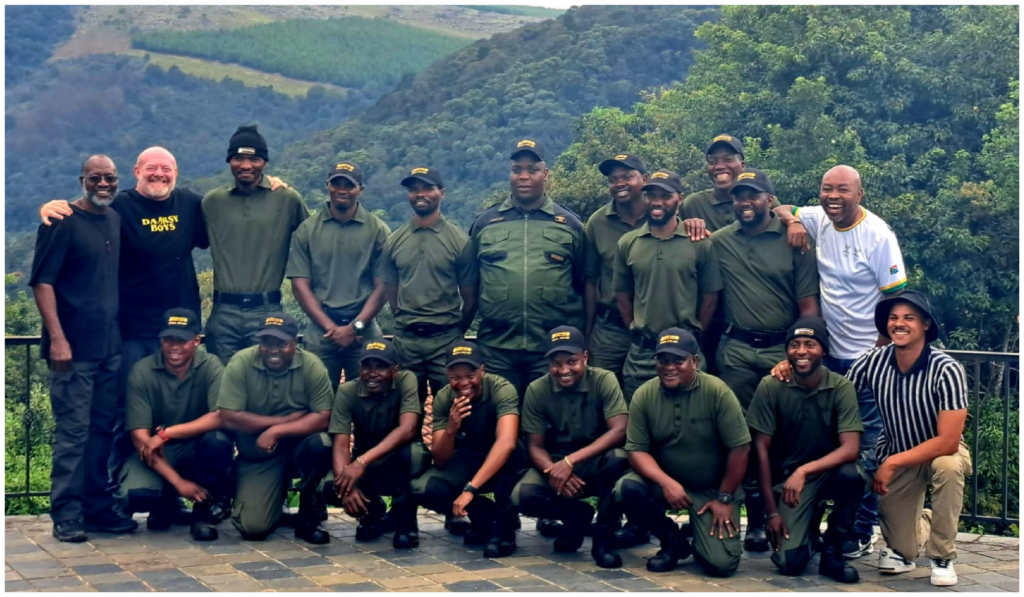
Operation Egoli, carried out on 12 November 2025, was led by Bidvest Protea Coin’s (BPC) Tactical Team in partnership with the South African Police Service (SAPS), including Crime Intelligence, and supported by Private Security Industry Regulatory Authority (PSIRA), Water Affairs and the Department of Mineral Resources and Energy (DMRE).
The raid produced a significant haul and left a large portion of the site’s illegal infrastructure unusable.
Our tactical teams destroyed 346 phendukas, 400 generators, 50 to 60 water pumps, 60 jackhammers and more than 800 informal camps.
They also removed and neutralised food supplies, gas cylinders, cutting torches, crucibles, amalgamated gold, borax, detonators, explosives, emulsion gels and ammunition using helicopters, tactical team members, armoured vehicles, drones and K9 units in a coordinated push designed to dismantle the network and secure the site.
For law enforcement and environmental teams, the operation was as much about restoring control as it was about seizing assets.
“What illegal miners had built here was not just a camp system, but an economy and a logistics chain,” said Roelof Schoeman, BPC General Manager for Canine, “Once you remove the generators, pumps, processing points and ammunition, you remove the ability to regroup quickly.”
Illegal mining in the area has, over the past decade, evolved into a parallel economy powered by syndicates, opportunistic miners and weak rehabilitation at abandoned or derelict mine sites.
The region’s historic mining ground, once a symbol of the province’s gold rush legacy, became a magnet for organised groups able to exploit shafts, water sources and abandoned infrastructure.
The first signs of the current escalation emerged years ago. In 2020, BPC dispatched an operative team to assess investor threats in the area as illegal extraction intensified.
After intensive research, a mixed and armoured workforce included Mozambicans, Zimbabweans and South Africans with children as young as 12.
By 2022, the first Basotho groups had arrived, and BPC began attempting to tax the miners operationally.
But the situation soon turned more violent.
A security source familiar with the terrain said the shift marked a turning point.
Within 18 months, Lesotho-based Mashai gangs expanded their footprint across Pilgrim’s Rest, Sabie, Graskop, Lydenburg and much of Mpumalanga.
By 2023, the network’s influence had hardened into something close to territorial dominance. Illegal miners weren’t just mining; they were policing the area themselves, taxing movement and controlling access to shafts, fuel, and buyers.
Project Egoli grew directly from months of reconnaissance and intelligence-gathering.
In May and June 2025, BPC tactical teams-built informant networks, mapped movement patterns and compiled video intelligence to trace how gold moved from the shaft to processing points and then into sales channels.
That intelligence shaped a 3-year plan built around force multiplication and containment.
Helicopter insertions, drone surveillance, armoured positioning and K9’s were used to secure the area from multiple directions.
SAPS supported poison-free encashment zones, allowing investigations to manage seized material and evidence without additional exposure risks.
The environmental damage had been severe. Cyanide processing had poisoned rivers, degraded soil, turned once-active mining ground into a toxic landscape – a sustained assault on an ecosystem.
The aftermath, however, suggested that disruption had begun to bite. Within months of the operation, rivers showed clear signs of recovery, water mongoose tracks had returned to the area, and land animals were moving back through previously contaminated zones.
Vegetation began to recover in sections where mining camps and processing paraphernalia had been removed.
The raid underscores the growing need for intelligence-driven and integrated responses to illegal mining, which has become more organised, more technical and more deeply tied to environmental destruction.
It also shows that disruption alone is not enough; sustained enforcement, cross-agency coordination and rehabilitation will be needed to prevent the network from re-establishing itself.
The operation also exposed the increasingly sophisticated nature of illegal mining groups, which now operate with supply chains, processing systems, security layers and cross-border labour networks that resemble formal enterprises.
These networks have become highly adaptive, using terrain, economic conditions, and gaps in enforcement more effectively than most people expect.
For BPC, the operation underscores a broader shift in security planning around mining and infrastructure.
“Integrated intelligence is no longer optional,” said Bino Fernandes, Specialised Services Divisional Executive. “It is the only way to deal with a threat that is mobile, armed and constantly evolving.”
The bigger challenge now is sustainability. While the raid delivered an immediate operational setback, the structural drivers behind illegal mining remain.
High gold values, abandoned sites, weak rehabilitation, environmental degradation and economic desperation continue to create ideal conditions for syndicates to regroup.
Still, Operation Egoli marks a significant turning point in Mpumalanga’s struggle with illegal mining.
It disrupted a major network, neutralised dangerous infrastructure and showed that coordinated action with governmental law enforcement can reclaim ground once considered lost.
Bidvest Protea Coin, in partnership with the South African Police Service, continues to support mining and infrastructure security through electronic surveillance, tactical response, aerial monitoring, intelligence operations and investigations.
In Mpumalanga, the latest operation marks a significant step in reclaiming ground from a criminal economy that had grown too embedded to ignore.